
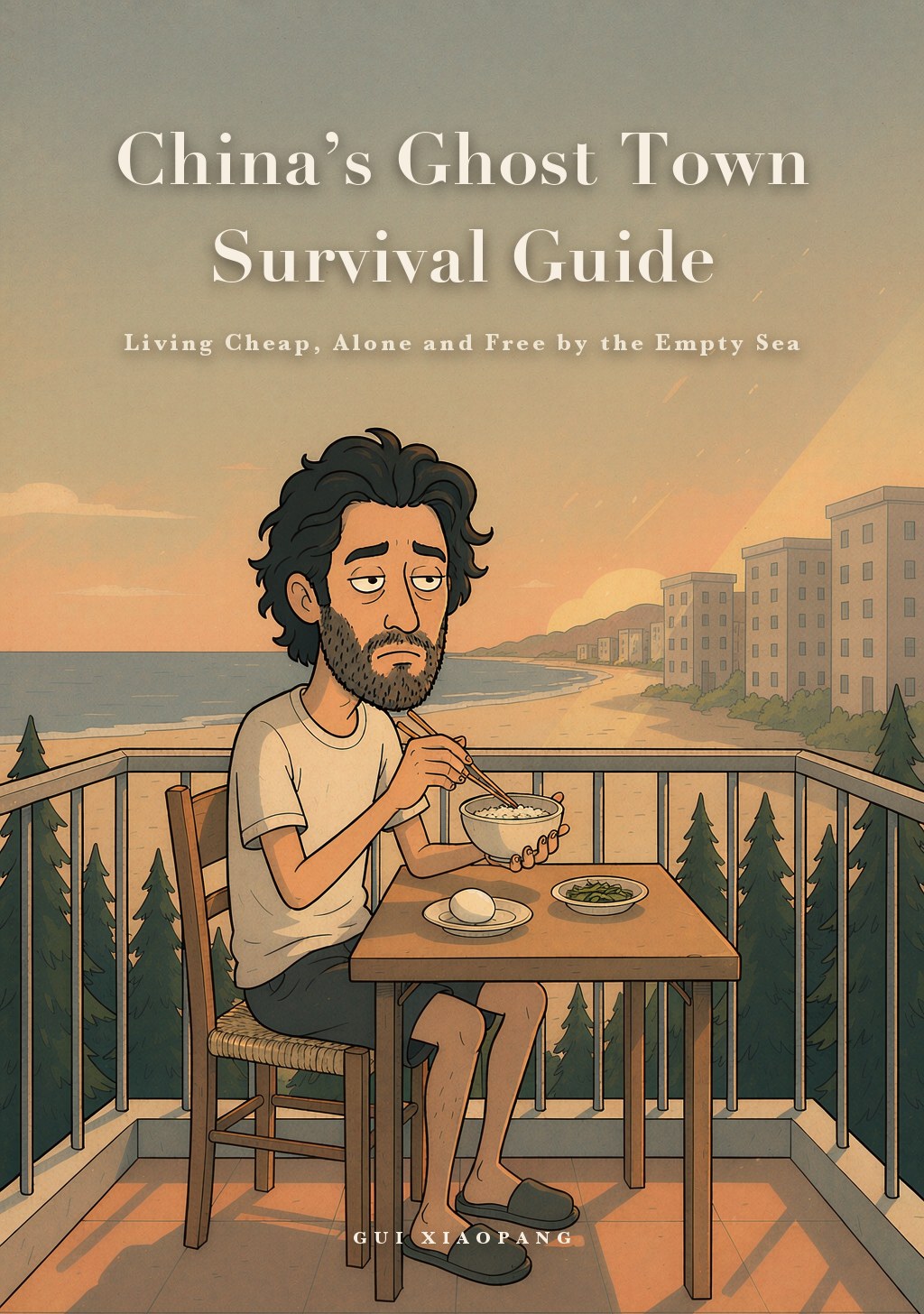
Living Cheap, Alone and Free by the Empty Sea
“It turns out quite a lot is left, and it is very quiet.”
How to get by, alone, in an empty seaside town, with no job — what it costs, where the money comes from, and whether the whole thing holds.
— Introduction —
On a Saturday in July 2022 he was on a bus, going home, doing arithmetic in his head. He had a job in Beijing, a flat, a salary — and a quiet feeling that the trade was a bad one, that he was paying for his life with his life.
By October he had resigned, packed what mattered, and taken a coach north along the coast to a town called Rushan Silver Beach, where he rented a two-bedroom flat, furnished, facing the sea, for four thousand yuan a year. Silver Beach was built for a million people. For ten months of the year, almost no one is there.
This book is not a memoir of feelings, and not a guide to getting rich in a cheap place. It is a survivor’s manual in the plainest sense: how to get by, alone, in an empty town, with no job — and what that actually costs. He shows the ledger to the yuan, the income that never once covered it, the savings that quietly close the gap, and the bill nobody sends.
It is also not a sales pitch. Nobody is recruited to anything. The book says plainly that there is no work here, that winter is a decision rather than a season, and that the silence which suits him would break somebody else.
— Table of contents —
10 chapters. Read in order, or open anywhere.
— What’s inside —
— Advance praise —
English first, Chinese beneath.
“Most books about quitting turn out to be books about the job. This one is about rent, wind, low tide and the price of soy sauce — and it is the calmest account I know of a life being taken apart and put back together, one ordinary Thursday at a time.”
“写“不干了”的书,最后往往变成写那份工作。这一本写的是房租、风、退潮和酱油的价钱。一个人把生活拆开,又在无数个平常的星期四里重新装好——这是我读过最平静的一份记录。”
— Eleanor Voss, The Tide Almanac
埃莉诺·沃斯,《潮汐历》
“The subtitle calls it a survivor’s guide and the book earns the word without ever raising its voice. It is the only account I have read that puts the whole ledger on the page — and then tells you the truth about what a cheap life is actually good for.”
“副标题说这是一本生存指南。整本书没有提高过一次嗓门,却把这两个字坐实了。我读过唯一一本把整本账摊开给你看的书——摊开之后,它才告诉你,便宜的日子到底好在哪里。”
— Tomás Iriarte, A Geography of Idleness
托马斯·伊里亚特,《懒惰地理学》
“Other countries have their hermits and their dropouts. It seems China now has a man in a rented flat with a notebook and a calculator. He never argues. He writes down what the day cost and what the sea did, and by the last page the argument has made itself.”
“别的国家有隐士,也有主动退场的人。中国似乎终于有了一个——坐在出租屋里,手里一个本子、一个计算器。他从不争辩。他只写下今天花了多少、海是什么样子;翻到最后一页,结论自己站了出来。”
— Sarah Okonkwo, Small Rebellions
莎拉·奥孔克沃,《小小的反叛》
“Nobody should read this book looking for permission. It gives none, and says so on nearly every page — no work here, mostly old people, winter a decision rather than a season. What it gives instead is something rarer: an actual year, costed and dated, with no conclusion bolted on.”
“别指望从这本书里拿到许可。它一点也没有,而且几乎每一页都在说:这里没有工作,镇上大多是老人,冬天是一个决定而不是一个季节。它给你的是更稀罕的东西——一个真实的、标了价的、带日期的年份,后面没有硬接一个结论。”
— Rei Arai, The Practice of Doing Nothing
荒井零,《什么都不做的练习》
“I have read a great many books about doing nothing. This is the first one in which nothing actually happens, and it is almost unbearable, and it is the truest thing I have read about a coast in winter.”
“关于“什么都不做”的书,我读过不少。这是第一本真的什么都没发生的。它几乎让人受不了——也正是我读过的、关于冬天的海岸最诚实的一本书。”
— Lin Zhiyuan, The Slow Boat South
林知远,《慢船去南方》
— The author —