
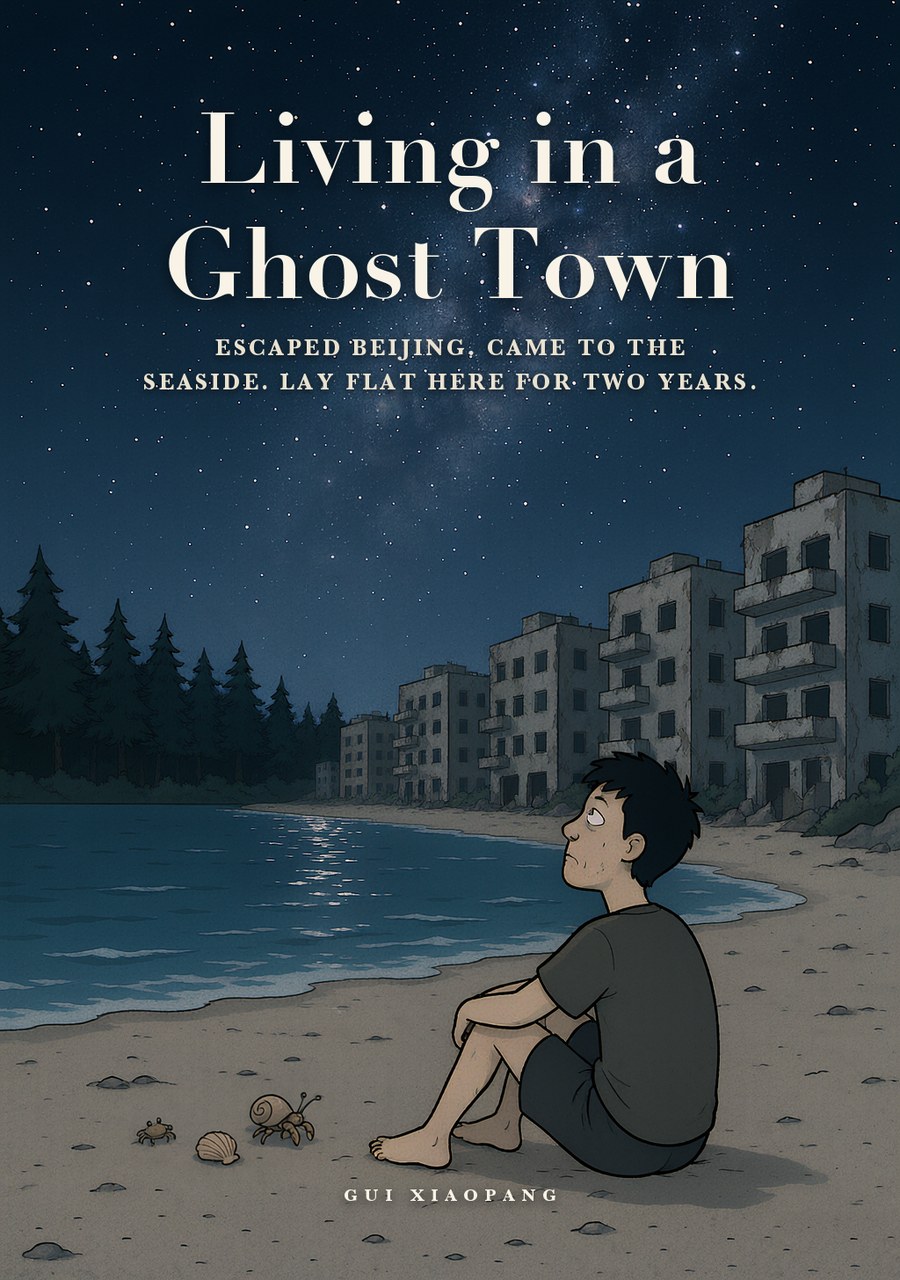
Escaped Beijing. Came to the seaside. Lay flat here for two years.
“Life can be open country, not a railway track.”
The first volume of the diary, in English: two years alone in a seaside town built for a million people — the rent, the tide, the market, the snow, and a life slowly rearranged.
— About the book —
In the summer of 2015, longing for life in the capital, he came to Beijing and became a drifter. Seven years went by; outwardly it looked glittering, but in truth there was nothing. He couldn’t afford a flat in Beijing, and the work wore him down in body and mind.
In the summer of 2022, against the backdrop of the pandemic, he resolved to quit bare-faced and escape Beijing, to go and live hidden away in a small seaside town. After weighing the choices he set his heart on the legendary “ghost town,” the “Hegang by the sea” — the Silver Beach resort in Rushan, Shandong. Flats there cost two to three thousand yuan a square metre, and renting is cheaper still: three or four thousand a year, against Beijing’s three or four thousand a month. One a paradise, one a purgatory.
At Silver Beach he found his inner peace; his spirit stopped being tense, his body stopped being taut. Every day he watched the sea and the sunset, went to bed early and rose early, and spent two easy, happy, free years — sea wind and evening glow, snow by the shore, swimming in the sea, foraging the shallows, the country market, pitch-dark nights and skies full of stars.
This is the diary of those two years, kept day by day: ordinary weather, small expenditures, and a life slowly rearranged around the tide.
— Table of contents —
41 chapters. Read in order, or open anywhere.
— What’s inside —
— Advance praise —
English first, Chinese beneath.
“The most unglamorous book about escape I have read. Nothing is sold here: not the sea, not the silence, not the freedom. He merely writes down what the day cost and what the weather did, and by the last page the case has made itself.”
“我读过最不煽情的“逃离”之书。这里不出售任何东西——不卖大海,不卖安静,也不卖自由。他只是写下今天花了多少、天气如何;翻到最后一页,理由自己站住了。”
— Eleanor Voss, The Tide Almanac
埃莉诺·沃斯,《潮汐历》
“A diary in the oldest sense: dates, weather, money, and a man deciding, again and again, to stay. It has the patience of low tide and not one line of self-congratulation.”
“这是一本最本分的日记:日期、天气、开销,和一个一而再、再而三决定留下的人。它有退潮那样的耐心,却没有一行自我陶醉。”
— Tomás Iriarte, A Geography of Idleness
托马斯·伊里亚特,《懒惰地理学》
“Four winters in a town built for a million and lived in by a few hundred. He never argues with the reader; he simply keeps the record, and the record is devastating in the quietest possible way.”
“在一座为一百万人而建、只住着几百人的小镇里过了四个冬天。他从不与读者争辩,只是把记录留着——而这份记录,用最安静的方式把人击穿。”
— Sarah Okonkwo, Small Rebellions
莎拉·奥康克沃,《小小的反叛》
“Other countries have their hermits. It seems China now has a man in a rented flat with a notebook and a tide table. He asks nothing of you, and tells you exactly what it costs.”
“别的国家有隐士。中国似乎有了一个——坐在出租屋里,手里一个本子、一张潮汐表。他不向你索取什么,只把代价一分不差地告诉你。”
— Rei Arai, The Practice of Doing Nothing
荒井零,《什么都不做的练习》
“I have read a great many books about doing nothing. This is the first in which nothing actually happens — and it is almost unbearable, and it is the truest thing I have read about a coast in winter.”
“关于“什么都不做”的书我读过不少。这是第一本真的什么都没发生的。它几乎让人受不了——也正是我读过的、关于冬天的海岸最诚实的一本书。”
— Lin Zhiyuan, The Slow Boat South
林知远,《慢船去南方》
— The author —